
A new study reveals that approximately 70 per cent of the year-to-year variation in winter air pollution across northern India can be explained by the frequency of western disturbances. These storm systems, originating from the Mediterranean, help clear pollution through precipitation and ventilation. The findings suggest that predicting the frequency of these disturbances could provide advance warning of severe pollution, allowing for better preparedness and implementation of control measures.

Over 2,000 pulmonologists and healthcare professionals from India and abroad will gather in Jaipur for NAPCON 2026 to discuss the increasing burden of pulmonary diseases and the critical impact of air pollution on lung health. The conference, organised by the National College of Chest Physicians, India, and the Indian Chest Society, will feature discussions on diagnosis, management, and prevention of conditions like COPD and asthma, alongside advances in interventional pulmonology.

A joint study by IIT Roorkee and IIT Kanpur has found that a black crust formed by air pollution is accelerating the deterioration of Humayun's Tomb, a UNESCO World Heritage Site in Delhi. The crust, primarily gypsum, traps pollutants, weakening the sandstone and making the monument vulnerable to long-term damage. The study recommends conservation measures, pollution monitoring, and source reduction to protect the historical site.
The Delhi government has approved real-time monitoring of PM2.5 and PM10 sources in collaboration with IIT-Delhi and the procurement of 30 EV-based mechanical road sweepers to combat winter air pollution. These measures aim to strengthen ground-level dust removal and scientifically identify pollution sources throughout the year.

Doctors have advised Delhi residents to take precautions like wearing N95 masks, avoiding outdoor walks, shifting exercise indoors, and installing air purifiers at home due to high pollution levels. Vulnerable groups, including children and the elderly, are particularly cautioned. Experts explain the seasonal rise in pollution and the impact of various factors on air quality.

These countries demonstrate how clean energy adoption, strong environmental policies and favourable geographical conditions can keep air pollution impressively low. According to the IQAir World Air Quality Report (2024), they consistently maintain annual average PM2.5 levels at or below the World Health Organization's stringent guideline of 5 g/m.
Delhi is set to begin trial runs of 22 innovative solutions aimed at tackling air pollution, following an 'innovation challenge' that received 284 applications. The trials will assess the effectiveness of various devices in reducing particulate pollution at identified hotspots across the city.
'It is high time to recognise that this is the greatest issue India is confronting.' 'Even the BJP should be raising concerns because polluted air suffocates everybody's child.'

As Delhi's winter wedding season coincides with severe air pollution, families and wedding planners are incorporating new measures like air purifiers, indoor venues, and even matching face masks into their celebrations to protect guests from poor air quality. This shift impacts venue choices, catering, and overall planning, with hotels being better equipped than farmhouses to manage air quality.

We are not acting at scale, by taking tough and time-bound action to bend the pollution curve, assets Sunita Narain.

A report by Envirocatalysts reveals that Delhi was the most polluted among 24 state and Union Territory capitals between Diwali 2025 and Diwali 2026, with annual average PM2.5 concentrations more than double the national standard. The analysis highlights that Diwali-day pollution contributes minimally to the overall annual exposure, with other sources like vehicles, dust, and industrial emissions being the primary culprits. The report calls for year-round clean-air action plans.
The Delhi government has partnered with IIT Madras to conduct a pilot study on 'smog-eating' surfaces using photocatalytic materials like Titanium Dioxide to combat air pollution.

New Delhi experienced its worst air quality in 287 days on Tuesday, with the Air Quality Index (AQI) reaching 350 and several monitoring stations reporting 'severe' pollution levels. PM2.5 was identified as the dominant pollutant, posing significant health risks. The city has been placed under Stage II of the Graded Response Action Plan, with stubble burning and transport emissions being major contributors to the deteriorating air quality.

A thick layer of smog enveloped parts of North India, including Delhi, Haryana, Punjab, and Western Uttar Pradesh, a day after Diwali celebrations. Air Quality Index (AQI) levels soared to 'very poor' and 'severe' categories, with Delhi recording its most polluted Diwali in five years. Residents reported severe health issues, prompting calls for urgent government intervention.
The East Delhi district administration conducted a trial using drones to spray water over dust-prone areas near Akshardham on Saturday. This initiative aims to control construction-related dust and combat air pollution, with officials exploring technology to make water sprinkling more efficient and cover larger areas.

The Supreme Court has mandated urgent action from Delhi and three neighbouring states (Uttar Pradesh, Rajasthan, Haryana) to tackle the sharp increase in vehicular emissions contributing to air pollution in the National Capital Region. The court has sought detailed responses on measures to prevent over-age vehicles, enforce emission standards, and improve inter-state coordination, highlighting the critical need for intervention despite a decline in stubble burning.

Mundane as it may seem, this is in some ways a metaphor for the challenges facing the nation, argue Arvind Subramanian and Devesh Kapur in their new book, A Sixth Of Humanity.

A political controversy erupted in Mumbai after the Brihanmumbai Municipal Corporation (BMC) removed actor Dia Mirza's video from its eco-friendly Diwali campaign. The video, which urged citizens to avoid firecrackers for environmental reasons, was taken down following objections from a BJP leader and comments from the Mayor labelling Mirza as "anti-Hindu." This move has drawn criticism from opposition parties, who accuse the BMC of succumbing to political pressure, while BJP leaders defended the removal, citing Mirza's past stances and alleged "anti-Hindu" views.

Delhi's air quality plunged into the 'severe' category for the first time this season on Friday morning, with the average Air Quality Index (AQI) hitting 403. Several monitoring stations reported even higher levels, prompting the invocation of Stage III of the Graded Response Action Plan (GRAP) to curb pollution.

A Lancet report reveals a significant increase in deaths attributable to PM2.5 pollution in India, with fossil fuels being a major contributing factor. The report highlights the economic and health consequences of air pollution and the urgent need for a transition to cleaner energy sources.

The Commission for Air Quality Management (CAQM) has implemented Stage 1 of the Graded Response Action Plan (GRAP) in Delhi-NCR after the Air Quality Index (AQI) deteriorated to the 'poor' category. Forecasts indicate the AQI will remain poor in the coming days, triggering restrictions like banning coal and firewood in eateries and limiting diesel generator use.

Chief Justice of India considers shifting Supreme Court hearings to virtual mode due to severe air pollution in Delhi after experiencing its effects firsthand.

Mahindra Last Mile Mobility won the Earthshot Prize 2026 in the "Clean Our Air" category for its work on electric rickshaws that makes the vehicles affordable to buy and run and provide sustainable solutions to combat air pollution.

Delhi Chief Minister Rekha Gupta announced a complete ban on construction activities from December 10 to January 20 to combat severe winter air pollution. The government will use its AI-powered Dust Portal 2.0 and AI-enabled cameras to monitor construction sites over 500 square metres in real-time, issuing alerts and fines for violations. Citizens are encouraged to report non-compliance.

The Bombay High Court criticized the Brihanmumbai Municipal Corporation (BMC) for its lack of action in addressing air pollution in Mumbai, questioning the approval of numerous large construction projects and urging preventive measures.

Delhi experienced its most polluted Diwali in five years with an average Air Quality Index (AQI) of 376, and the day after the festival saw only a marginal improvement, remaining in the 'very poor' category at 371, accompanied by a thick blanket of smog and fog.

The Delhi government has announced a series of stringent measures to combat air pollution in the national capital ahead of winter. These include prohibiting construction activities, restricting entry of non-BS-VI vehicles, doubling parking charges, implementing staggered office timings, and strengthening public transport, alongside public awareness campaigns and infrastructure improvements.

Delhi's air quality slightly deteriorated on Wednesday, moving into the 'poor' category with an AQI of 232, and is forecast to worsen to 'very poor' by Friday due to unfavourable meteorological conditions. PM2.5 remains the dominant pollutant, with vehicular emissions and biomass burning identified as major contributors. The city also experienced its coldest morning of the season.
Doctors and researchers are increasingly concerned about the potential link between exposure to polluted air during pregnancy and its influence on foetal development, particularly the male reproductive system. While hypospadias, a common congenital abnormality, is multifactorial, endocrine-disrupting chemicals in air pollution are being investigated for their role. Experts call for more research and advise expectant mothers on preventive measures.

Gurugram police seized over 580 kilograms of illegal firecrackers in the Badshahpur area ahead of Diwali. A joint team conducted a raid on Monday evening, arresting one man, Rajkumar, for allegedly selling the crackers. An FIR has been registered, and further investigation is underway regarding the source of the crackers, as the sale and storage of traditional firecrackers are banned in Delhi-NCR due to air pollution concerns.

Delhi's air quality slipped into the 'very poor' category for the first time this season on Monday, with an AQI of 312. This triggers Stage 2 of the Graded Response Action Plan (GRAP), leading to stricter measures to control pollution. Minimum temperatures were also noted.
Don't ignore symptoms like coughing, wheezing or shortness of breath, warns Dr Sandeep Tilve.

The ODI series opener between India and Sri Lanka on December 13, 2026, has been moved from Delhi's Feroz Shah Kotla to Visakhapatnam. The shift was requested by the DDCA due to concerns over potential weather disruption, high air pollution, and ongoing renovation work at the Arun Jaitley Stadium.

From dust and allergens to microscopic pollutants and airborne viruses, indoor air can contain several invisible contaminants. Air purifiers with advanced filtration and smart sensors can help tackle these concerns. Here are some models that promise cleaner indoor air with powerful purification and real-time monitoring.

'If you keep on irritating the body by allowing all kinds of pollutants to get into it, the body cells are going to get irritated and cancer will come.'

A new analysis by the Centre for Science and Environment (CSE) reveals that Delhi-NCR's early-winter air pollution has reached a three-year high in the week preceding Diwali. The average PM2.5 concentration significantly increased compared to previous years, driven primarily by vehicular emissions and regional pollution inflow. The report highlights the failure of year-round pollution control measures, with Diwali firecrackers exacerbating an already deteriorating situation, and notes the emergence of new pollution hotspots and the ineffectiveness of emergency traffic restrictions.

Delhi cabinet minister Parvesh Verma launched a sharp attack on the previous AAP government, alleging failure to carry out basic civic works over the past decade, leading to issues like garbage mountains, broken roads, pollution, and Yamuna cleaning.

The Supreme Court stated it is not inclined to completely ban firecrackers but emphasised the need for authorities to implement existing orders on the ground to combat air pollution in Delhi-NCR. The court highlighted that annual orders become a "mockery" without proper enforcement and urged serious action, public awareness campaigns, and on-ground officer presence. It also noted ongoing consultations regarding the use of Barium in firecrackers and discussed measures taken by the Delhi government and CAQM to tackle pollution, including curbs on vehicles and construction. The court reiterated its stance of finding a middle ground rather than a complete ban or round-the-clock fireworks.
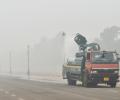
On November 18, the apex court directed all Delhi-NCR states to immediately set up teams to strictly enforce anti-pollution GRAP 4 restrictions, making it clear that the curbs would continue till further orders.

The negative health effects from air pollution exposure are infertility, metabolic syndrome and polycystic ovary syndrome.
